
In the Financial year 2013-14 there were encouraging signs on the foreign trade front as India's trade deficit recorded a sharp fall.

'Every year we import approximately $70 billion worth of gold -- closer to $72 billion in 2025-2026, an all-time record.' 'There is no parallel for this anywhere in the world. And this love for gold will not disappear overnight.'

Head of the Iranian Parliament's National Security Committee Ebrahim Azizi on Saturday said that Iran has prepared a "professional mechanism" to regulate maritime traffic in the Strait of Hormuz through a designated route, which will be unveiled soon.

While the import of gold fell by about 11 per cent to $2.58 billion in February as against $2.89 billion in the corresponding month last fiscal, inward shipments of petroleum products were down by nearly 8 per cent to $9.37 billion.

The deal shifts the US posture towards India from hostile to neutral, and that matters for growth, points out T T Ram Mohan.

Officials from both India and the US in the recent past have indicated that a "fair deal" will be concluded soon, with Indian officials holding that more formal rounds of talks are not needed.

Imports during October also rose by 17.62 per cent to $44.11 billion, leading to widening of trade deficit to $17.13 billion.

Merchandise exports rose 13.47% year-on-year in October to $27.27 billion.
Imports also fell for the eighth consecutive months, down 0.75 per cent to $41.14 billion in January, widening the trade deficit to a seven-month high of $15.17 billion.

India's exports surged by 11 per cent to $131.47 billion in the first quarter of this year but with imports registering an over 27 per cent growth, the country's trade deficit widened, official figures stated.
The decline in exports is mainly on account of poor demand in India's key destinations -- the Europe and the US -- and it may take some more months for the situation to improve. The demand scenario is "not looking very good as far as Europe is concerned, and the US also we have seen a decline in demand. "For the next 2-3 months, I think the demand scenario does not look very optimistic," DGFT (Director General of Foreign Trade) Santosh Kumar Sarangi told reporters.

India's net oil import bill could rise by $56 billion to $64 billion annually assuming global crude averages $110 to $115 per barrel in FY27.

Overall, merchandise imports rose 10.9 per cent to $41.95 billion.
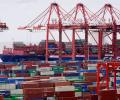
The country's exports surged 49.85 per cent to $35.43 billion in July on account of healthy growth in petroleum, engineering, and gems and jewellery segments, even as the trade deficit widened to $10.97 billion during the month, official data showed on Friday. Imports during the month also rose by about 63 per cent to $46.40 billion, as per the data released by the commerce ministry.
India's exports rose by 22.36 per cent to $33.81 billion in February on account of healthy growth in sectors like engineering, petroleum and chemicals, even as the trade deficit widened to $21.19 billion, according to preliminary data released by the commerce ministry on Wednesday. Imports during the month too jumped by about 35 per cent to $55 billion, with inbound shipments of petroleum and crude oil surging 66.56 per cent to $15 billion. The trade deficit -- the difference between imports and exports -- stood at $13.12 billion in February 2021.
Exports contracted by 2.6 per cent to $34.47 billion in September even as the country's merchandise trade deficit narrows to $19.37 billion during the month under review, according to the government data released on Friday. Easing commodity prices helped in cutting down the country's import bill by 15 per cent to $53.84 billion in September, the 10th consecutive month of decline. During April-September this fiscal, exports contracted by 8.77 per cent to $211.4 billion.

Gold imports last month jumped to $4.17 billion from $1.09 billion a year ago.

India's exports jumped 45.76 per cent to $33.28 billion in August on account of healthy growth in segments like engineering, petroleum products, gems and jewellery and chemicals, even as the trade deficit widened to a four-month high of $13.81 billion.

Imports of machinery and transport equipment grew about 40 per cent month-on-month

Imports too declined by 16.31 per cent to $37.39 billion.

Cumulative exports during April-October 2017-18 increased by 9.62 per cent to $170.28 billion, while imports grew by 22.21 per cent to $256.43 billion, leaving a trade deficit of $86.14 billion.

India's exports jumped by 19.37 per cent to $38.13 billion in November, while imports dipped by 1.88 per cent to $62.66 billion, according to government data released on Monday.

The country's exports declined marginally by 0.8 per cent to $26.89 billion in December 2020, due to contraction in sectors like petroleum, leather and marine products, according to preliminary data released by the commerce ministry on Saturday. The trade deficit in December widened to $15.71 billion, as imports grew by 7.6 per cent to $42.6 billion, the data showed. Export in December 2019 was $27.11 billion, while imports stood at $39.5 billion.

The central bank is yet to consider actions such as a rate hike or mobilising dollar inflows from non-resident Indians to boost forex reserves as it cannot afford to continue with them for long when the rupee's internationalisation tops its agenda, explains Tamal Bandyopadhyay.

Foreign investors pulled out Rs 21,000 crore (around $2.3 billion) from Indian equities over the last four trading sessions amid deteriorating global risk sentiment triggered by the West Asia crisis.

The short-term risk to our external balances stems from the yellow metal.

Oil imports were up 49.46 per cent to $11.5 billion on back of surge in international crude prices.

The country's current account deficit widened to 4.4 per cent of the GDP in the quarter ended September, from 2.2 per cent GDP during the April-June period, due to higher trade gap, as per data released by the Reserve Bank on Thursday. "India's current account balance recorded a deficit of $36.4 billion (4.4 per cent of GDP) in Q2:2022-23, up from $18.2 billion (2.2 per cent of GDP) in Q1:2022-23 and a deficit of $9.7 billion (1.3 per cent of GDP) a year ago [i.e., Q2:2021-22]," the RBI said.

'FPIs are unlikely to return unless there is equilibrium between valuation premium and earnings growth.'

The measures announced by it risk backfiring, disrupting the foreign exchange market, and intensifying the very pressures they seek to contain, with broader consequences for the economy points out Rajeswari Sengupta.
Sectors, which, recorded healthy export growth included electronics, engineering, chemicals, pharma and tea.

Along with rising exports, the imports too went up by 54.1 at $40.9 billion during the month, pushing up the trade deficit to $15 billion during May. Imports grew highest in the last four years.

Reserve Bank of India (RBI) Governor Sanjay Malhotra stated that preventing second-round effects of supply shocks, where inflation expectations rise due to prolonged disruptions, is the primary role of monetary policy. He also defended the RBI's foreign exchange market interventions, asserting it did not commit to an 'indefensible peg'.

Leading Indian jewellery bodies, including the All India Gem & Jewellery Domestic Council (GJC) and Malabar Gold & Diamonds, have expressed support for Prime Minister Narendra Modi's appeal to reduce gold imports and are advocating for enhancements to the Gold Monetisation Scheme (GMS) to unlock India's vast idle gold reserves.
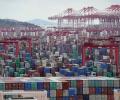
India's exports fell 9 per cent to $23.43 billion in November due to a drop in shipments of segments such as petroleum products, engineering and chemicals, even as the trade deficit narrowed to $9.96 billion during the month, according to official data released on Wednesday. Imports also slipped 13.33 per cent to $33.39 billion in the month under review. In November, oil imports dipped 43.34 per cent to $6.27 billion. It was down by 48.7 per cent to $44.10 billion during April-November 2020, the data showed. Exports during April-November 2020 were $173.49 billion, compared with $211.17 billion during the corresponding period a year ago, exhibiting a negative growth of 17.84 per cent.

'Once the market decides it wants to go up, it goes up -- no amount of bad news can really hold it back.'
The demand of imports coupled with rising international crude oil prices has widened the overall trade deficit in the first half of the current fiscal to $20.3 billion from $11.9 billion a year ago, Reserve Bank said on Tuesday.\n\n

The country's exports dipped 8.74 per cent to $23.52 billion in November on account of contraction in shipments of key sectors like petroleum, engineering, chemicals and gems and jewellery, official data showed on Tuesday. Trade deficit during the month narrowed to $9.87 billion as imports too declined by 13.32 per cent to $33.39 billion.

The NSE Nifty too fell sharply by 68.55 points, or 0.67 per cent, to settle at 10,118.05.
Exports rose by 24.22 per cent to a monthly record high of $38.19 billion in April on account of healthy performance by sectors like petroleum products, electronic goods and chemicals, even as trade deficit widened to $20 billion during the month, the commerce ministry said on Tuesday. Imports during the month under review grew by 26.55 per cent to $58.26 billion. The trade deficit in April 2021 was at $15.29 billion.
